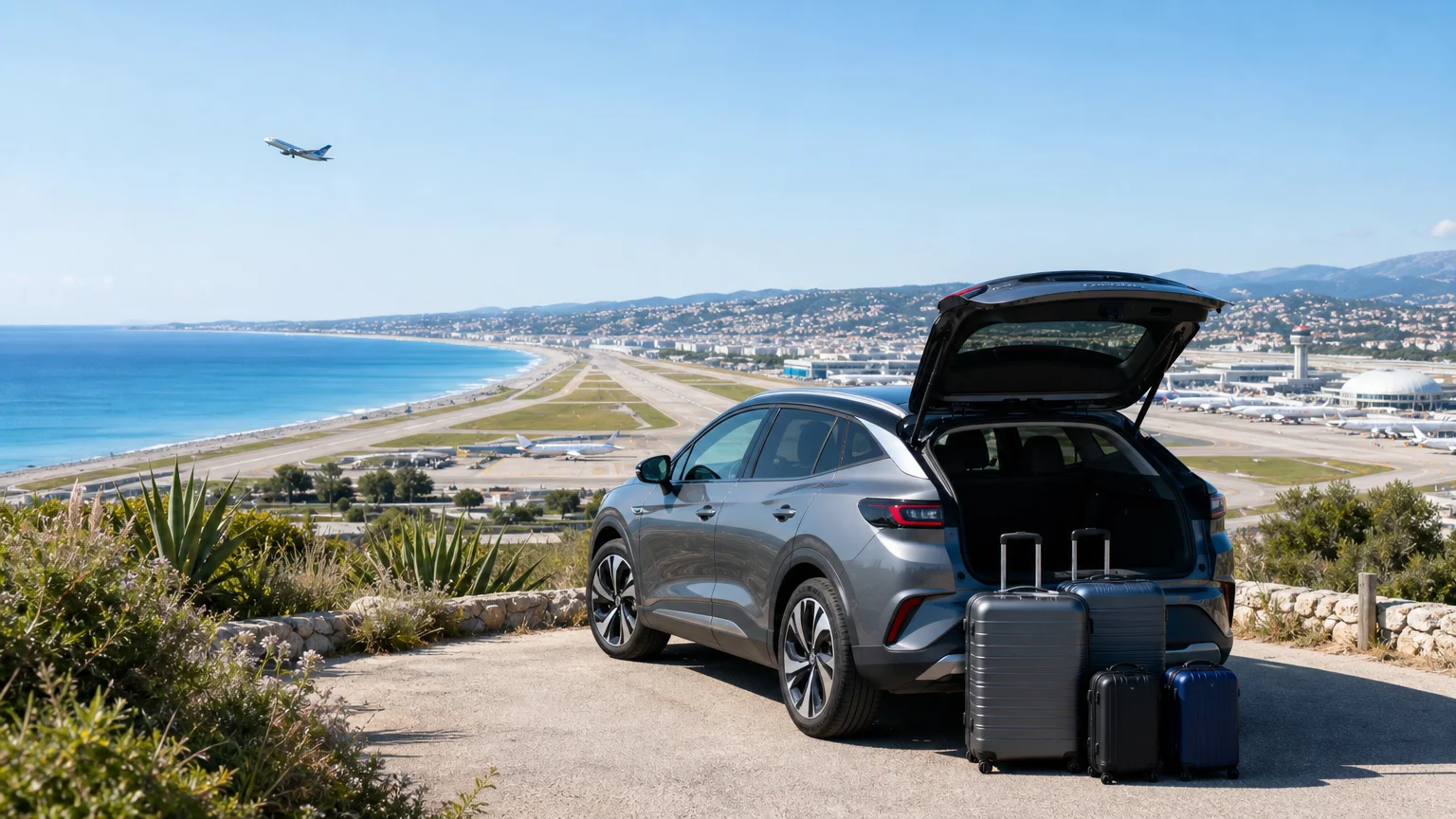

With more than 15 million commercial passengers handled in 2025, Nice Côte d’Azur Airport is a major gateway to the French Riviera. A practical Nice airport guide should therefore begin with the details that prevent avoidable delays, especially the difference between Terminal 1 and Terminal 2, the location of public transport, and the meeting arrangements for a private driver. Our Nice Côte d'Azur Airport guide provides a useful reference for the airport layout and arrival process.
The airport sits west of central Nice, close to the Promenade des Anglais, and connects directly with the city by tram. The airport operator’s 2025 passenger figures show why planning matters: the airport handled 15.23 million commercial passengers in 2025, an increase of 3.2% over 2024. During busy periods, a few minutes spent checking your terminal and transport plan can make the first stage of your trip much easier.
What should you know about Nice Airport before landing?
Nice Côte d’Azur Airport has two main passenger terminals. Terminal 1 and Terminal 2 are connected by airport shuttles and free tram services on the short route between the airport facilities and Grand Arénas. Your airline and booking confirmation should be the final reference for your departure terminal because airline arrangements can change with seasonal schedules.
For an arrival, follow the signs for baggage reclaim and the public arrivals area before heading to your chosen transport. If somebody is collecting you, agree in advance whether you will meet at an arrivals exit, a designated pickup area or another clearly identified point. This is particularly important when several flights arrive close together and the terminal becomes crowded.
For a departure, allow time to reach the correct terminal, check in, pass security and walk to your gate. International journeys can require additional formalities, so a sensible plan is to confirm the airline’s recommended arrival time rather than relying only on the distance between the airport and your hotel.
How do you travel between Nice Airport and the city?
The tram from Nice Airport is usually the simplest public transport choice for central Nice. Line 2 serves both terminals and continues toward Jean Médecin and Port Lympia. The journey to the city centre takes less than 30 minutes in normal conditions, and trams generally run frequently during the day. Check the destination shown on the tram because the route toward CADAM is not the one that continues through central Nice.
The train is useful when your destination is Cannes, Antibes, Monaco, Menton or another coastal town. Nice Saint-Augustin station is close to the airport, with Terminal 1 within walking distance and Terminal 2 connected by shuttle or tram. The train can be efficient, although it requires a transfer from the terminal and may be less convenient with several suitcases or a stroller.
Buses provide additional routes toward Antibes, Cannes, Monaco, Menton and inland destinations. Some services leave from the Terminal 2 bus station, while others use stops near Terminal 1 or the Grand Arénas transport hub. Tickets and schedules can vary, so check the current operator information before boarding. Our guide to transportation from Nice Airport can help you compare these options with taxis and private transfers.
Public transport is often the most economical option for one traveler carrying light luggage. It becomes less attractive when you arrive late, have young children, need a precise hotel drop-off or are traveling to a destination away from the main rail corridor.
When is a taxi or private transfer more practical?
A taxi is available from the airport taxi ranks at the terminals and can take you directly to your accommodation. It is a practical choice when you want to leave immediately without checking routes or handling luggage through a station. The fare structure depends on the destination and applicable airport or city rules, so confirm the price basis before departure.
A pre-booked private transfer adds a different type of convenience. Instead of searching for a vehicle after baggage reclaim, you can provide your flight number, arrival time, passenger count, luggage details and destination in advance. The driver can then coordinate the pickup, contact you after landing and direct you to the vehicle. For more detail about local taxi arrangements and alternatives, see our guide to Nice airport taxis.
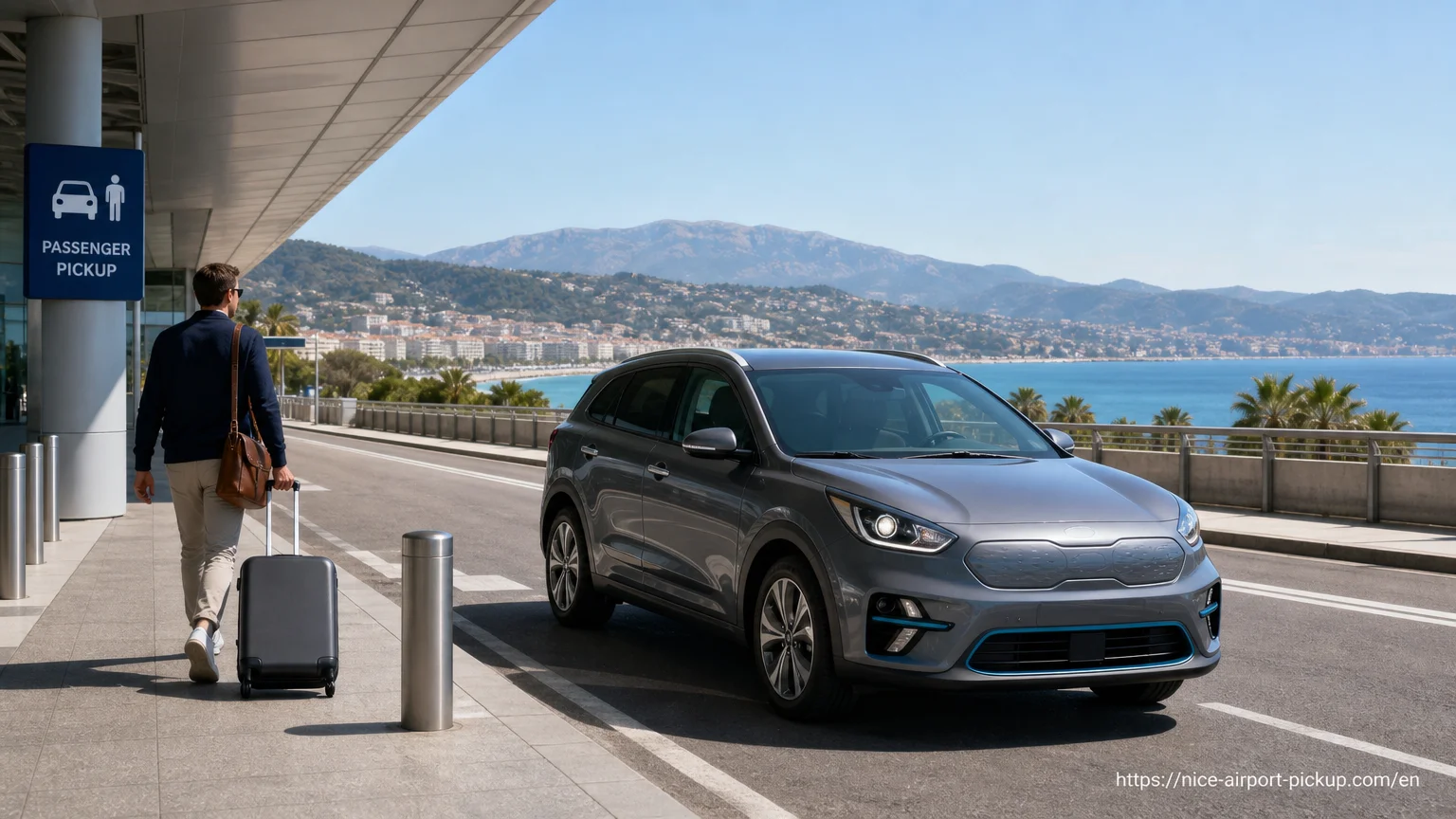
For airport arrivals with Nice-Airport-Pickup, the stated process includes flight monitoring when a flight number is supplied, post-landing contact, a sign bearing the customer’s name at the arrivals exit, luggage assistance and an escort to the vehicle. Airport pricing includes 60 minutes of waiting, made up of 30 minutes from the scheduled landing time and an additional 30 minutes offered by the chauffeur.
The difference between these options is not simply price. It is also about predictability. A tram requires you to find the platform and carry your belongings through the network. A taxi requires you to join the correct rank and confirm the destination. A private transfer requires advance booking, but it can reduce uncertainty at the moment when you are tired, unfamiliar with the airport or traveling with children.
What should families and travelers with luggage plan for?
Families should arrange child seating before traveling rather than assuming a suitable seat will be available at the airport. In the stated French regulatory context, children under 10 must use an appropriate child-restraint system. Transporting a child without suitable equipment can create safety and legal difficulties for the driver.
On the Nice-Airport-Pickup website, families can request child seats, rear-facing infant seats and booster seats free of charge during booking, subject to the options and conditions shown in the booking flow. The available R44/04 options described for the service include a rear-facing Group 0+ infant carrier for children weighing 0 to 13 kg, a Group 0+/1 seat for children weighing 9 to 18 kg and 15 to 36 kg depending on the restraint position, and booster seats for children from 15 kg, generally around 4 to 10 years old.
Give the child’s age and weight when booking so the requested equipment can be considered correctly. One or more seats may be provided depending on the number of children and the options available in the reservation process. Families should also check the space required for pushchairs and personal bags.
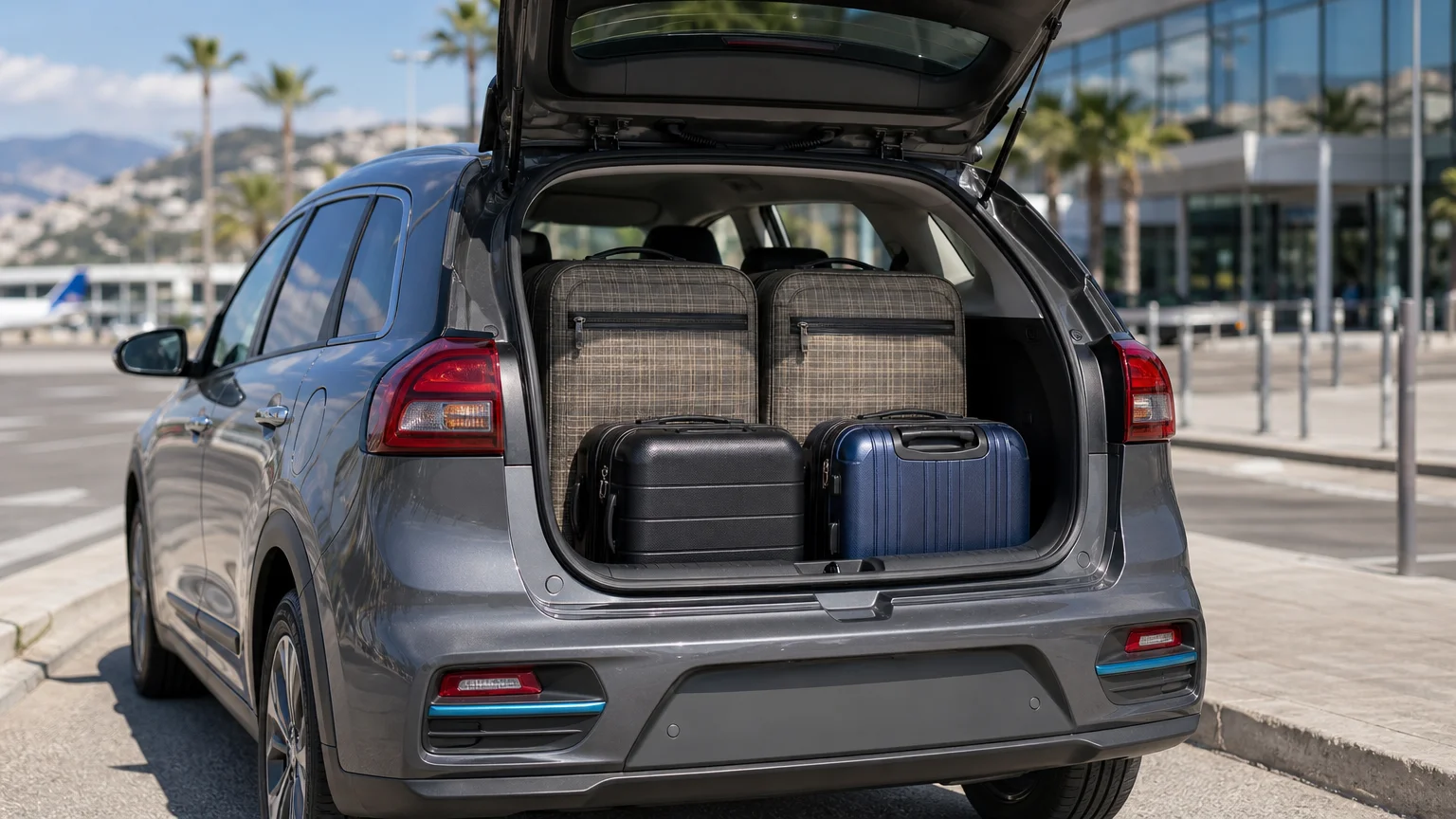
The airport-transfer vehicle is an electric 2021 grey Kia e-Niro, with a maximum capacity of four passengers. Its trunk can hold a maximum of two large checked suitcases and two cabin suitcases, subject to their dimensions and the actual space available. If your group has more luggage, sports equipment or an unusually large stroller, ask for confirmation before booking rather than relying only on the passenger count.
Compared with a large combustion engine car, an electric vehicle avoids tailpipe exhaust during the local journey. That does not remove the wider environmental impact of travel, but it is a relevant consideration in an enchanting and environmentally fragile coastal region such as the French Riviera.
How much time and money should you allow for a private transfer?
Private transfer prices depend on the route, travel date, time, passenger count, luggage and whether you choose a one-way or return journey. The exact estimate is calculated during the reservation process. A return journey booked with the outbound trip is priced at twice the one-way fare, less 10 percent.
Several operating conditions should be understood before confirming a booking:
- Night journeys between 22:00 and 07:00 carry a 10 percent surcharge.
- Sunday and French public-holiday journeys carry a 10 percent surcharge.
- City appointments include five minutes of waiting, followed by a charge of 12 euros per started 15-minute period.
- Airport transfers include 60 minutes of waiting under the stated airport conditions.
- Additional airport waiting costs 12 euros per started 15-minute period.
- A flight arriving more than 60 minutes after its scheduled landing time incurs the same 12-euro charge per started 15-minute period.
Allow approximately 45 minutes after landing for disembarkation, baggage collection and customs before expecting to meet your driver. This estimate is useful when deciding whether to book a transfer immediately after the scheduled landing time or to allow a realistic pickup window.
For a city transfer, a public taxi or tram may be sufficient. For a family, a late arrival or a direct trip to Monaco, Cannes, Menton or another Riviera destination, the value of a private transfer lies in the coordination. Our practical guide to stress-free airport arrival in Nice explains how meeting instructions, flight details and luggage assistance can reduce uncertainty.
Which Riviera destinations are easiest from Nice Airport?
Central Nice is the most straightforward destination by tram, taxi or private car. The tram reaches areas around Jean Médecin, the Promenade and Port Lympia, while the train is useful for Nice-Ville and onward coastal travel. A direct vehicle is often more convenient when your accommodation is in the Old Town, on a hillside or outside the main public transport corridor.
Antibes and Cannes can be reached by train, bus, taxi or private transfer. The train is attractive for travelers who are comfortable changing from the airport connection to the rail network. A private vehicle is more direct for travelers with luggage or for those staying away from the station.
Monaco and Menton are also accessible by train and regional buses. The train offers a scenic route along the coast, but a private transfer can be useful when you need door-to-door service, have children or want to continue to several destinations in one day.
Villefranche-sur-Mer, Èze, Beaulieu-sur-Mer, Saint-Jean-Cap-Ferrat, Grasse and Saint-Tropez require more individual planning. Nice-Airport-Pickup provides regional chauffeur journeys to listed French Riviera destinations, while destinations not listed in its booking flow require a quotation through the reservation form.
The airport’s importance extends beyond arrivals in Nice. A regional tourism report recorded 15.23 million commercial passengers at Nice Côte d’Azur Airport in 2025, with international traffic increasing by 4.7% that year. The figure reinforces the practical point for travelers: popular routes and major events can put pressure on roads, trains and vehicles at the same time.
What should you check before booking your airport journey?
A few checks can prevent most avoidable problems:
- Confirm whether your flight arrives at Terminal 1 or Terminal 2.
- Record the full destination address, including the hotel name and municipality.
- Count passengers, checked bags, cabin bags, pushchairs and special equipment.
- Give the flight number when arranging an airport pickup.
- Request child seats during booking and provide each child’s age and weight.
- Allow around 45 minutes after landing for airport formalities.
- Allow extra road time during the Cannes Festival, Monaco Grand Prix and Monaco Yacht Show.
- If you are boarding a cruise, plan to reach the ship at least 90 minutes before its latest return-to-board time.
Official airport figures vary slightly in presentation because some publications round the passenger total. The airport group’s 2025 financial statements give the commercial passenger total as approximately 15.2 million, consistent with the more precise 15.23 million figure published elsewhere for 2025.
The same principle applies to transport prices and journey times. Treat online estimates as planning information, then confirm the exact destination, travel period and conditions during booking. This is particularly important for nighttime journeys, Sundays, public holidays, event periods and routes beyond central Nice.
Choose the airport plan you can follow easily
The best Nice airport transfer plan is the one that matches your arrival time, luggage, family needs and final destination. Use the tram or train when low cost and independence matter most, and consider a taxi or pre-booked private vehicle when direct coordination, child seating, luggage assistance or regional travel are more important. Check the terminal, allow time after landing and confirm every surcharge or waiting condition before departure.
Arrange Your Nice Airport Transfer
Once you know your terminal, destination and luggage requirements, booking in advance can make the arrival process simpler. It is especially useful for families, late flights and travelers continuing directly to Monaco, Cannes, Antibes, Menton or another French Riviera destination.
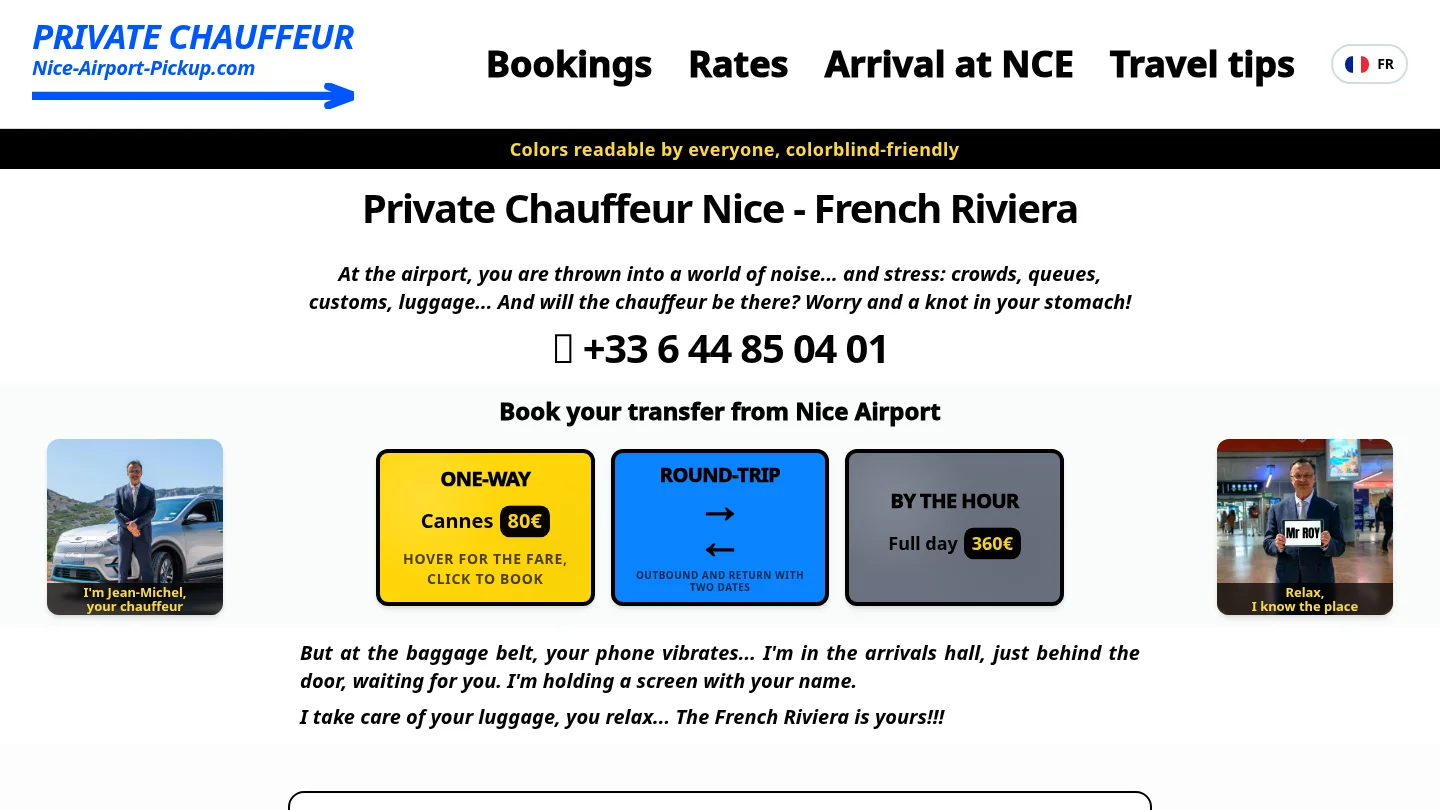
We provide pre-booked private airport transfers with flight monitoring when a flight number is supplied, post-landing contact, a named meeting sign, luggage assistance and escort to the vehicle. The electric Kia e-Niro service accommodates up to four passengers and a maximum of two large checked suitcases plus two cabin suitcases, subject to available space. Families can request child seats, rear-facing infant seats and boosters free of charge during booking. Book a private Nice airport transfer and provide your flight, destination, passenger and luggage details.
Frequently Asked Questions
How far is Nice Airport from central Nice?
Nice Côte d’Azur Airport is west of central Nice, close to the Promenade des Anglais. The tram usually reaches the city centre in less than 30 minutes, while a direct road journey can be shorter or longer depending on traffic and the exact destination.
Is the tram or train better from Nice Airport?
The tram is usually more convenient for central Nice because it serves both terminals directly. The train is useful for coastal destinations such as Antibes, Cannes, Monaco and Menton, but you must first reach Nice Saint-Augustin station.
Can families book child seats for a Nice airport transfer?
Yes. Nice-Airport-Pickup allows families to request child seats, rear-facing infant seats and boosters free of charge during booking, subject to the options and conditions shown in the reservation flow.
How much luggage fits in the airport-transfer vehicle?
The stated maximum is two large checked suitcases and two cabin suitcases, subject to dimensions and available trunk space. The vehicle also has a maximum capacity of four passengers, so larger groups or travelers with bulky equipment should request confirmation before booking.
How early should I arrange a private transfer?
Book as soon as your flight, accommodation and destination are confirmed, especially during major Riviera events. For airport arrivals, allow approximately 45 minutes after landing for disembarkation, baggage collection and customs, then provide the flight number so the pickup can be coordinated.