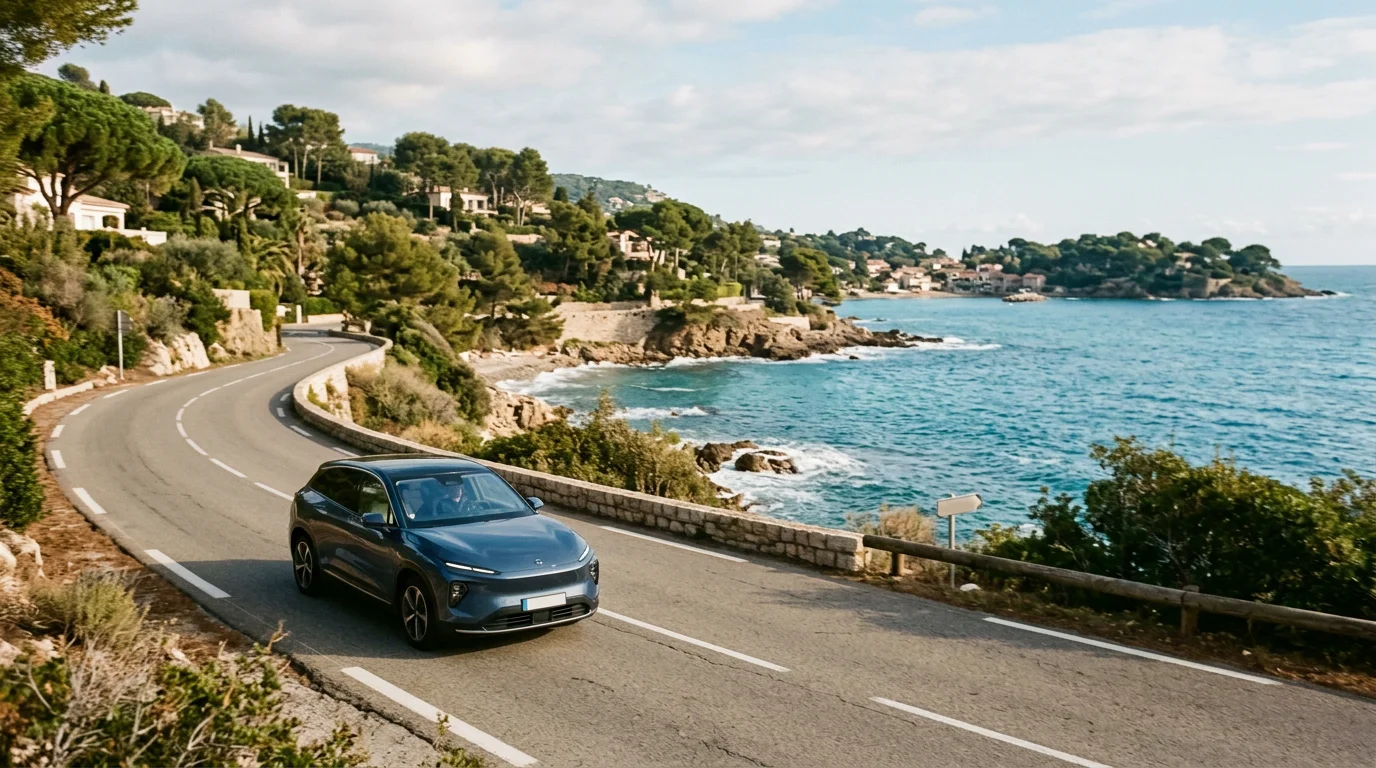

Each summer, a village of roughly 4,000 permanent residents welcomes close to a million visitors, and a great many of them land first at Nice Côte d'Azur Airport. Reaching this celebrated corner of the coast comfortably begins with selecting the right transfer, which is precisely where our St Tropez to Nice Airport transfer service makes the difference.
The appeal is easy to understand. According to an industry reference, Saint-Tropez hosts an estimated 800,000 to 1 million visitors during the peak July and August months. Yet the resort has no commercial airport of its own, so the transfer from Saint-Tropez to Nice Airport becomes a practical necessity for most international travelers. Understanding your distance, timing, cost and comfort options in advance is the key to a calm departure or a relaxed arrival on the Riviera.
How far is Saint-Tropez from Nice Airport?
Travelers searching for a St Tropez to Nice Airport transfer face a road journey of approximately 105 to 110 kilometres. The drive typically takes about 1 hour 40 minutes, although coastal traffic in high season can extend that figure. The route follows the A8 motorway before descending toward the Gulf of Saint-Tropez.
The region draws remarkable numbers. As noted on Tourism in France, the French Riviera welcomes more than 10 million tourists a year, making it the country's second leading destination after Paris. That volume translates into busy roads during the summer, so planning your airport transfer ahead of time is strongly advised.

Comparing your transfer options
Several ways exist to bridge the distance between the airport and the resort, and each suits a different priority. A private chauffeur offers direct comfort, a taxi provides flexibility at a higher cost, and public transport is economical but slow. The table below compares the practical differences.
| Option | Approx. travel time | Door-to-door | Typical cost |
|---|---|---|---|
| Private chauffeur (our service) | About 1h40 | Yes | Flat fare confirmed at booking |
| Taxi | About 1h40 | Yes | Around €200 to €350 |
| Train and bus | 3 hours or more | No | Lower, but with several changes |
Public transport requires several connections and rarely serves Saint-Tropez directly, which lengthens the trip considerably. If you prefer the simplicity of a single vehicle from door to door, our guidance on choosing an airport shuttle service explains what to look for before you commit.
What a private chauffeur transfer includes
Picture stepping off a long flight and finding your name already displayed in the arrivals hall. That single detail removes much of the uncertainty that surrounds a new arrival. A private chauffeur waits for you, assists with luggage, and monitors your flight so a delay does not leave you stranded.
Beyond convenience, the service brings predictability. We work directly with you, without an intermediary platform, so your trip is planned around your schedule rather than a fixed timetable. Our chauffeur is based next to Nice Côte d'Azur Airport, which supports a responsive pickup, and a flat fare agreed in advance means the cost is clear before you travel. For a broader view of how these transfers work, consult our Nice Airport Transfers guide.
How much should you budget for the journey?
Cost is often the deciding factor. A taxi for this route generally ranges between €200 and €350, depending on the operator and the time of booking. Private chauffeur services usually apply a flat fare that is confirmed when you reserve, which protects you from meter surprises in heavy traffic.
Prices across the Riviera reflect strong seasonal demand. France welcomed a record 102 million foreign tourists in 2025, as reported in the same French tourism overview, and summer peaks push availability to its limits. Booking early therefore secures both a better rate and a guaranteed vehicle. To understand the full range of pricing structures, review our breakdown of airport transfers in 2026.

Timing your transfer for a smooth arrival
When should you travel? Season matters enormously on this stretch of coast. Official statistics on tourist accommodation around Saint-Tropez confirm that activity concentrates heavily in the warm months, when roads and beaches fill quickly.
During July and August, allow extra buffer time and aim for a mid-morning or mid-afternoon departure to avoid the heaviest coastal congestion. Outside the peak, from late autumn through early spring, the route flows freely and travel times shorten. Whichever period you choose, confirming your pickup details the day before helps guarantee a calm, punctual start to your Riviera stay.
Conclusion
The essential figure to remember is simple: about 105 kilometres and roughly 1 hour 40 minutes separate the airport from the resort by road. Public transport stretches that to three hours or more with several changes, while a taxi mirrors the private drive time at a variable price. A pre-booked flat fare gives you the clearest budget and the least stress. For a journey along one of the world's most admired coastlines, comfort and reliability are worth planning for, and a dedicated chauffeur who greets you personally and adapts to your flight turns a long transfer into part of the holiday itself. To begin with confidence, reserve our private St Tropez airport transfer for your travel dates.
Frequently Asked Questions
How long does the transfer from Saint-Tropez to Nice Airport take?
By road, the journey takes approximately 1 hour 40 minutes across a distance of about 105 kilometres. Traffic during the summer season may extend this, so allow additional time when you travel between June and September.
Is a private chauffeur better than a taxi for this route?
A private chauffeur offers a fixed fare agreed in advance and flight monitoring, whereas a taxi charges a variable rate. With our private transfer service, the price is confirmed at booking and a driver waits for you in the arrivals hall.
Can I book a return trip at the same time?
Yes. We recommend arranging your outbound and return transfers together so both dates are secured. This is particularly useful during peak season, when demand for vehicles is at its highest.